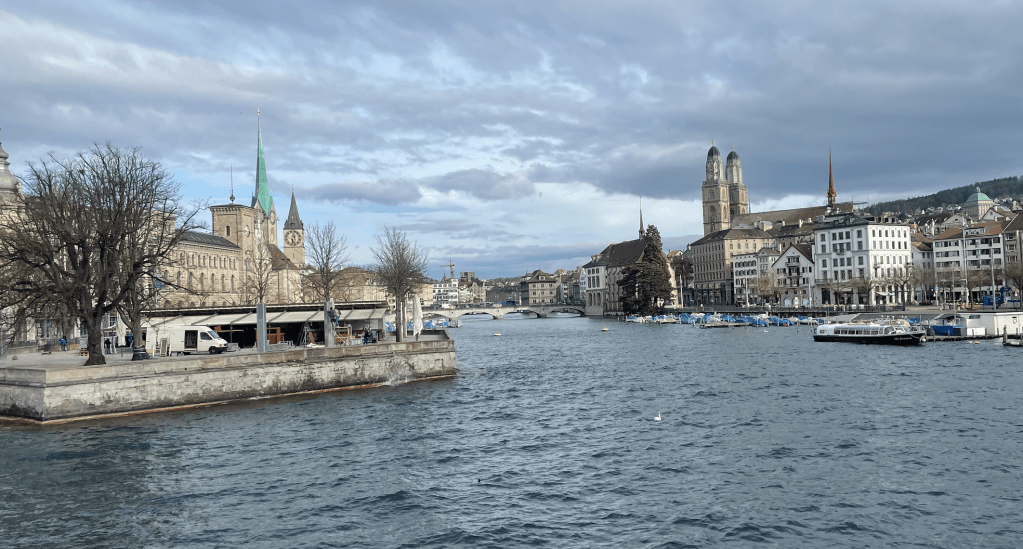
I can see how I am going to end in trouble for this post: as I have no intention of writing just a fraction of what the topic deserves, and I can’t possible add all the footnotes that would be necessary. But I want to write about the other day when I took some teenaged guests for sightseeing and in due course pointed out the Grossmünster where Zwingli had chosen to be minister. Naturally, the teens were massively bored by this bit of information. That challenged me to try explaining why they actually should be excited.
Really, old dudes quarrelling?
Many feel that religion is something of the past that has merely folkloristic value and should otherwise be best forgotten and abolished. Why bother about some inner-church conflict that happened 500 years ago? Do I care about Roman imperial succession, or who was the last reigning Mogul?
The funny thing with history is that we don’t even notice how much we actually care. We are formed by those events and discussions. They shape our deep-rooted values and assumptions.
I fear that I can only get it wrong, but I my angle was that it boils down to the big question of whether the larger mass of individuals should follow authority blindly, or if anyone might be able to communicate with the highest authority directly.
Think for yourself
My young guests knew of course, that back then the bible was solely in ancient languages that most people did not understand. So, most people heard about god and how important it was to get this relationship right if they did not want to end up in eternal hell. But you had no means of doing it on your own. Priests were the intermediaries with all the keys in their hands.
So, along comes this reformist idea that we should make this most important of all books accessible to all by translating it into the local language. We no longer scare people into submission about the great unknown and at the same time make them pay big sums to buy their way into forgiveness. Instead, the individual is empowered by hearing and understanding the scripture itself.
This led to many new insights and ideas. Who gets to say what is right or wrong? Who is the boss? Do we have a strict social hierarchy of those in the know and those who blindly follow, or is the individual enabled to study at the source, form its own opinion and form communities with shared responsibilities?
Up to this day, many discussions boil down to the same big questions: who gets to decide? How much freedom has the individual and what is the prize for that freedom?
Forming different state concepts
Thinking how the US were founded by pilgrims who went looking for a new world to live their vision of religious communities, it might explain a lot of very fundamental differences between European and American assumptions about the role of the individual and the duties, care and boundaries the community and state should provide. We then wondered if we can support this claim with examples from societies which were strongly shaped by catholic colonisers.
After my longish rant about all this, my young guests were possibly stunned into silence. But they agreed that is actually far from being a dusty topic. Just because we don’t visit church on Sundays, it does not mean that its history has no longer any traction in our lives.
Set free to ask
What we take for granted today, is often the result of long and winding processes throughout time. And while this could mean that it is all so complicated that we can never give sufficient answers on any topic, I believe that we sometimes have to go on wild rants to try to make it come to life.
In general, I believe that while it might be impossible to get the answer right, it is never wrong to ask many questions!

 Content Creation Matters
Hinterlasse einen Kommentar